

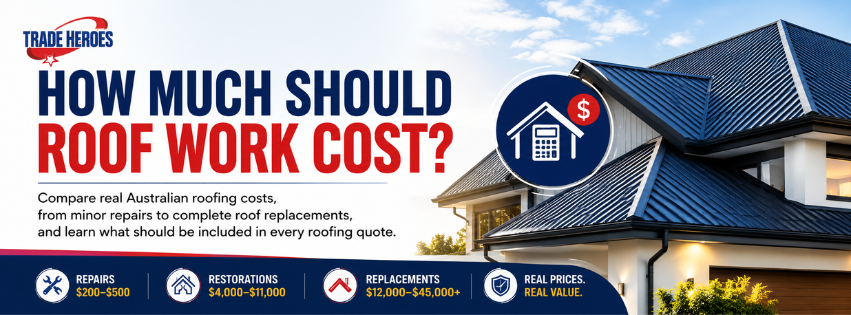
How Much Should Roof Work Cost
 Danielle
Roofs fail quietly. There is no warning light. Usually it starts as a brown ring on a ceiling that you tell yourself has probably always been there, and then one wet fortnight it is definitely bigger.
By the time you start ringing around, you get a spread of numbers that makes no sense. One quote says $9,000, the next says $34,000, and neither explains why.
Part of that is genuine. A handful of cracked tiles and a full re-roof are different jobs. But part of it is that almost every roofing cost guide in Australia is quoting figures with nothing behind them. So this guide does something different. It uses the one independent cost source that actually exists, tells you what it excludes, and then covers the three things that matter more than the price: who is legally allowed to touch your roof, whether your job is covered by statutory insurance, and why replacing tiles with metal is riskier than anyone selling it will tell you.

What The One Independent Source Says
The Archicentre Australia Cost Guide 2026 is the only free, dated, itemised Australian source publishing residential roofing rates. It is not a regulator or a quantity surveying institute, but it is not a lead-generation site either, which puts it ahead of everything else in circulation.
| Roof Covering | Indicative Rate Per Square Metre |
|---|---|
| Steel Roofing, Standard To Marine | $60 to $130 |
| Concrete Tiled Roof | $65 to $85 |
| Terracotta Tiled Roof | $105 to $155 |
| Slate Tiled Roof, Traditional System | $390 to $650 |
| Fibreglass Roof | $48 to $70 |
| Sarking | $11 to $16 |
Archicentre Australia Cost Guide 2026, including GST, for work up to two storeys fixed to an existing roof frame.
Read that last line carefully, because it is the whole game. These rates are for the covering fixed to an existing frame. They exclude stripping and disposing of the old roof, scaffolding, structural upgrades, batten or frame work, and anything to do with asbestos. On a real re-roof those items are a substantial part of the bill.
Guttering is priced separately by the linear metre: PVC $43 to $72, Zincalume $43 to $102, Colorbond $49 to $109, copper $138 to $187 and stainless steel $120 to $215.
If you want to sanity-check a quote, multiply your roof area by the relevant band, then treat everything above that as strip-out, access, structure and margin. It will not give you a price, but it will tell you whether a number is in the right postcode.
What Does Not Exist
There is no other independent Australian roofing benchmark. Rawlinsons publishes rates in its Australian Construction Handbook, but that is a $650 paid reference. BMT's cost table has no roofing line items at all. Neither CHOICE, the Housing Industry Association nor Master Builders publishes roofing prices.
So when you see confident ranges for spot repairs or roof restoration, check where they came from. Most trace to quote marketplaces or roofing company blogs, which are not neutral parties. We would rather tell you that than invent a number.
One correction worth making, since the figure circulates widely: tile roof replacement is often quoted as a single $100 to $180 per square metre band. Archicentre splits it, and concrete tile sits well below that at $65 to $85. Lumping concrete and terracotta together overstates the cheaper option considerably.
Who Is Legally Allowed To Work On Your Roof
This is the part that genuinely surprised us, and it is the most useful thing in this guide. Roofing is licensed completely differently depending on which state you are in, and in one state it is barely licensed at all.
| State | Position On Roofing Licences |
|---|---|
| VIC | Metal roofing is plumbing work. The Building and Plumbing Commission states that work on metal roofs can be undertaken only by registered or licensed plumbers. Roof tiling is a separate building registration, and a roof tiler cannot install skylight flashing |
| NSW | Roof plumbing is a licensed trade covering guttering, downpipes, flashing and metal roof coverings. Roof tiling and roof slating are separate licence categories. Licence required above $5,000 in labour and materials |
| QLD | Licensed by the QBCC, not as plumbing. Roof and wall cladding is one licence, roof tiling another. Licence required above $3,300 |
| TAS | Roof (stormwater) plumbing is a licence class, but a licensed builder may install metal roof sheeting without it, though not the downpipes |
| SA | No roof plumbing licence category. Roofing falls under the building work contractor licence, which subcontractors also need |
| WA | No roofing or roof plumbing licence exists. Building and Energy licenses only builders, building surveyors, painters, plumbers and gasfitters |
Same roof, same job, completely different consumer protection depending on your postcode. In Victoria a metal re-roof can only be done by a licensed plumber. In Western Australia there is no roofing trade licence to hold.
Every state publishes a public register, and checking takes about a minute. It is worth doing, because the consequences of not doing it are documented. Queensland's building regulator issued 313 fines for unlicensed contracting in 2022-23, and confirms that defective work done without a licence gets no cover under the Home Warranty Scheme. In New South Wales, one operator was fined $26,000 with $31,200 compensation for unlicensed residential work that included gutter repairs.
Whether Your Job Is Insured Might Surprise You
Statutory home warranty insurance kicks in at wildly different values around the country, and roof replacements land right in the gap.
| State | Scheme | Threshold |
|---|---|---|
| QLD | Queensland Home Warranty Scheme | More than $3,300, and the QBCC names roof restoration and repair specifically |
| VIC | Domestic Building Insurance | Over $16,000 |
| NSW | Home Building Compensation Fund | Over $20,000 including GST |
| WA | Home Indemnity Insurance | Over $20,000 |
| SA | Building Indemnity Insurance | $20,000 or more, raised from $12,000 on 10 November 2025 |
Work through what that means for a typical $18,000 re-roof. In Queensland and Victoria it is covered. In New South Wales, Western Australia and South Australia it is not. Same job, same money, no statutory protection if the contractor disappears or the work fails.
If your quote is sitting just under a threshold, that is worth a conversation.
The Finding That Should Change How You Think About Metal
Converting a tile roof to Colorbond is the most common upsell in Australian roofing. There is a government investigation into what happens next, and it is not encouraging.
In July 2021 Western Australia's Building and Energy division, working with James Cook University's Cyclone Testing Station, examined storm damage to Perth roofs. It found that in metropolitan Perth, roughly half of all roof failures during storms involved lightweight metal sheet cladding that had replaced original heavy tile or asbestos cladding. Those modified roofs were damaged even when winds did not exceed the speeds that building standards require them to withstand.
The two recurring causes were work proceeding without the required permits and licences, and inadequate structural tie-downs.
That is worth sitting with. A roof structure designed to carry the weight of tiles behaves differently once that weight is removed, because tile roofs rely partly on mass to stay put and metal roofs rely entirely on fixings. Swap one for the other without upgrading the tie-downs and you have a lighter roof with the same connections.
None of which means metal is a bad choice. It means the conversion is a structural change, not a cosmetic one, and the quote should reflect that. Ask specifically what happens to the tie-downs and whether an engineer has looked at it.
Do You Need A Permit?
You will read that a building permit is required if you replace more than 20 per cent of a roof. That rule does not exist in Australia. It is a United States code convention, and it has been copied into a great deal of Australian content.
What actually triggers approval here is the nature of the work.
In Victoria, the regulator's position is that repairing parts of a roof is exempt maintenance, but full replacement of elements does not constitute repair and must be treated as an alteration. In Queensland, roofing is not among the exempt categories, and councils list re-roofing as requiring a development permit for building work. In Western Australia, Building and Energy states that changing roof materials requires a building permit and a qualified professional such as a structural engineer or registered builder.
So the practical test is: are you patching, or are you replacing? And are you changing the material? Patching is generally maintenance. Replacing is generally an alteration. Changing from tile to metal is a structural change, which is precisely the pathway the WA investigation found people were skipping.
Permit fees vary by council and by private building surveyor, and are not published in any comparable national form, so ask rather than budget from a generic figure.
Choosing A Material, Properly
The usual comparison runs on price and looks. The thing that actually determines whether your roof lasts is specification, and for metal that means how far you are from the sea.
Coastal Distance Is A Specification, Not A Preference
BlueScope publishes minimum distances for its steel roofing products, and they are specific. Colorbond steel in Classic and Matt finishes is specified for use more than 200 metres from breaking surf or exposed marine environments. Colorbond Ultra is specified for more than 100 metres. SUPERDURA Stainless is specified from zero metres, meaning it can go right at the surf line. Zincalume and Colorbond in Metallic finishes require more than 200 metres from breaking surf and more than 100 metres from calm marine environments.
The difference is coating mass. Standard Colorbond sits on an AM100 substrate; Colorbond Ultra sits on AM150, a 50 per cent heavier coating.
This matters commercially. A quote that says "Colorbond" without naming the grade is not comparable to one that does, and if you are within a couple of hundred metres of the water the wrong grade will fail early and the warranty will not help you.
On that: BlueScope does not publish a single universal warranty period for Colorbond. Its published sample warranties are templates with placeholders, and state that any period shown is for demonstrative purposes only. The real period depends on the product, the application and the site, is subject to eligibility, and must be applied for. The widely circulated figures you see on roofing company pages do not come from BlueScope documents.
The warranty also carries conditions people routinely breach, including a requirement for six-monthly fresh water washing of areas not normally washed by rain, and exclusions for contact with incompatible materials such as lead, copper and run-off from copper flashings.
Tiles
Concrete and terracotta tiles remain the default across older Australian suburbs, and individual broken tiles are cheap to replace, which is a genuine advantage over sheet.
Monier warrants its concrete and terracotta tiles against manufacturing defects, with a separate colour retention warranty on terracotta. Worth knowing that the warranty terms stated on Monier's website and in its warranty documents differ on the period, so confirm directly before relying on a number. The warranties also require registration within 12 months, exclude weathering and colour change, exclude tiles removed and reinstalled, and are not transferable to a new owner.
Asphalt Shingles
The article version of this section usually claims shingles are the cheapest option and growing in popularity here. Neither claim is supportable. No Australian industry or government dataset on roof cladding market share exists, and the only independent cost guide does not list asphalt shingles at all, while pricing steel from $60 and concrete tile from $65 per square metre. Shingles are a legitimate choice for particular roof forms. They are not obviously the budget option in this market.
Slate
Slate is the premium end at $390 to $650 per square metre installed, several times the cost of anything else, and it needs a structure that can carry it. For heritage work it is often the only appropriate answer. For most homes it is not competing on value.
Roof Restoration, And A Word Of Caution
Restoration usually means cleaning, replacing broken tiles, rebedding and repointing ridge caps, and recoating. On a sound but weathered tile roof it can genuinely extend service life.
Two things to know before you buy one.
First, roof restoration is not a defined or regulated term anywhere in Australian building law. It is not a licence class. In Queensland the work splits across separate licences, with roof and wall cladding covering refurbishment but expressly excluding terracotta and concrete tiles, roof tiling being its own licence, and painting belonging to painters. So "restoration" describes a sales package, not a regulated scope. Get the inclusions in writing.
Second, this corner of the trade has an enforcement history. Consumer Affairs Victoria lists roof repairs by name among the services used by what it calls fake tradies, and publishes a case of a consumer losing more than $10,400 on guttering work that failed to meet building standards. Western Australia's Consumer Protection and Building and Energy issued a joint warning about roof repair conmen operating door to door, after three men charged a homeowner $7,000 for work that was not performed and damaged the roof in the process.
If someone knocks on your door about your roof, you have protections. Under the Australian Consumer Law an unsolicited consumer agreement carries a 10 business day cooling-off period, during which the seller cannot supply the service or take payment. Door-to-door callers may only visit weekdays between 9am and 8pm and Saturdays between 9am and 5pm, never Sundays or public holidays, and must leave immediately when asked. In Western Australia a builder cannot demand a deposit exceeding 6.5 per cent of the total value of the work.
If Your Roof Might Contain Asbestos
Asbestos cement roofing is common on older Australian homes. WA Health gives the practical identifiers: the brand name Super Six, usually seven ridges per one metre wide panel, and diamond shaped metal fasteners.
A homeowner may remove up to 10 square metres of non-friable asbestos without a licence. A whole roof is always well beyond that, so whole-roof asbestos removal always requires at minimum a Class B licensed removalist, and a Class A licensee for anything friable.
The single most important rule here, and it is enforced across multiple states: never allow anyone to high pressure clean an asbestos roof. WorkSafe Queensland states there is no system of use that can effectively capture or suppress asbestos fibres in those circumstances, and issued an incident alert in January 2026 after a painting contractor spread asbestos contaminated debris across neighbouring properties and a public road. SafeWork NSW lists high pressure water spray among prohibited equipment for asbestos work. WA Health calls it dangerous and illegal. Painting an asbestos roof is generally permitted as a surface treatment, using gentle wet preparation methods. Pressure washing it to prepare for painting is not.
No government or independent body publishes a cost benchmark for asbestos roof removal, so get quotes from licensed removalists rather than budgeting from an online figure.
Bushfire, And One Myth Worth Killing
If you are on bushfire prone land, AS 3959 sets roof requirements from BAL-12.5 upward. Roof tiles, sheets and covering accessories must be non-combustible, roof and wall junctions sealed against openings greater than 3 millimetres, and roof penetrations sealed with non-combustible material. At BAL-29 gutters must be metal or PVC-U. At BAL-40 gutters must be non-combustible and roof lights need a fire resistance level. At Flame Zone the roofing system must be tested to AS 1530.8.2.
Here is the myth. Gutter guard is not required at any BAL. The standard requires only that if leaf guards are installed, they must be non-combustible. That is a meaningfully different thing from the way gutter guard is often sold.
Worth knowing too that in bushfire areas, supports for solar collectors count as roof penetrations that must be sealed. Re-mounting panels after a re-roof is a compliance event, not just an electrical one.
Why A Properly Set Up Contractor Costs More
Roof work is among the most dangerous jobs in residential construction, and the numbers explain why a serious quote includes scaffolding or edge protection.
Safe Work Australia recorded 25 workers killed in falls from roofs between 2003 and 2011, with roof repair the single most common activity. The finding that matters for homeowners: half of those deaths involved falls of three metres or less, mostly from residential properties. Single storey is not low risk.
The fall risk duty has no minimum height. The two metre figure people quote relates to paperwork, because construction work with a risk of falling more than two metres is high risk construction work requiring a safe work method statement. It is not the point at which safety starts mattering.
And compliance is patchy. SafeWork NSW ran a falls from heights campaign in 2025 across 935 workplace visits, issuing 1,058 compliance notices and $223,950 in fines. On roof work specifically, only 60 per cent of sites had higher order controls such as scaffold, roof guard rails or elevated work platforms in place. Two in five roof jobs inspected did not.
If one quote includes scaffold and another does not, they are not the same quote.
Frequently Asked Questions
The questions below come up most often once people start comparing.
How Much Should A Roof Replacement Cost?
The only independent Australian guide, Archicentre's 2026 Cost Guide, puts roof coverings fixed to an existing frame at $60 to $130 per square metre for steel, $65 to $85 for concrete tile, $105 to $155 for terracotta and $390 to $650 for slate, including GST. Those rates exclude strip-out and disposal, scaffolding, structural work and asbestos, all of which are real costs on a re-roof. No government or consumer body publishes a total price for a roof replacement.
Do You Need A Licensed Plumber For A Metal Roof?
In Victoria, yes. The regulator states that work on metal roofs can be undertaken only by registered or licensed plumbers. In New South Wales metal roof coverings fall within roof plumbing, which is licensed. In Queensland it is a QBCC roof and wall cladding licence rather than a plumbing licence. In Western Australia there is no roofing licence at all. Check your state's public register before you hire.
Is Roof Restoration Cheaper Than Replacement?
Generally yes, but restoration is not a regulated term and no independent source publishes a price for it, so what you are buying depends entirely on the written inclusions. It suits roofs that are weathered but sound. If the roof is failing structurally, restoration delays rather than solves. Get the scope in writing and be wary of unsolicited door-to-door offers.
Do You Need A Permit To Replace A Roof?
Usually yes for a full replacement, and almost certainly if you are changing materials. There is no "20 per cent of the roof" rule in Australia, despite how often it appears online. Victoria treats full replacement as an alteration rather than maintenance, Queensland councils list re-roofing as requiring a building permit, and WA requires a permit plus a qualified professional when roof materials change.
Can You Convert A Tile Roof To Colorbond?
Yes, but treat it as a structural change. A WA Building and Energy investigation with James Cook University found that around half of Perth storm roof failures involved lightweight metal cladding that had replaced tile or asbestos, failing even below the wind speeds standards require them to withstand, with inadequate tie-downs and missing permits among the recurring causes. Ask what happens to the tie-downs and whether an engineer has assessed it.
What Should You Check Before Hiring A Roofer?
Their licence on your state's public register, whether the quote names the actual product grade rather than just "Colorbond", whether scaffolding or edge protection is included, whether the job sits above your state's home warranty insurance threshold, and what the strip-out, disposal and structural allowances are. Those five answers tell you more than the total does.
Compare Roofing Contractors With Trade Heroes
The honest summary is that roofing prices in Australia are poorly documented, roofing licensing is wildly inconsistent, and the most commonly sold upgrade carries a structural risk that a government investigation has already measured.
So compare on scope rather than on the number at the bottom. Ask for the product grade, the strip-out and disposal allowance, the access and safety provisions, and what happens to the roof structure if the material is changing. Check the licence. Check whether the value puts you above or below your state's insurance threshold.
Trade Heroes is a directory. We list roofing contractors by location so you can compare them and contact them directly. We do not do roof work, we do not price it, and we do not take a cut of the job.
You can find roofing specialists through Trade Heroes in Perth
, Sydney
, Adelaide
, Hobart
, Brisbane
or Canberra
, or browse the full roofing directory
.
Related Posts

Aug 01, 2025
 Danielle
House Painting Cost Guide
Understanding House Painting Cost: A Comprehensive Guide
Read more »
Aug 01, 2025
DanielleHow Much Do Blinds Cost in 2026
How Much Do Blinds Cost? A Comprehensive Breakdown for Every Budget
Read more »